


















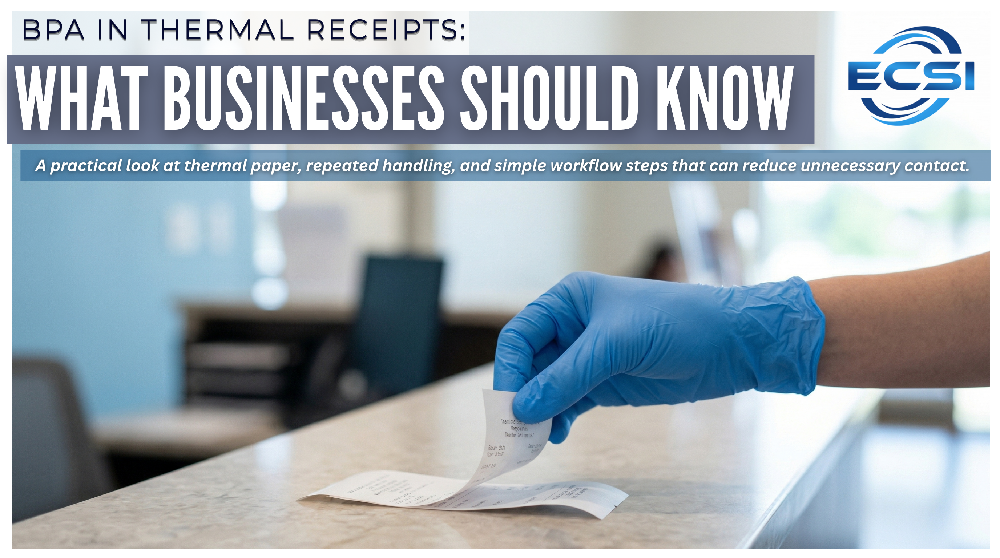
Most people do not think twice about receipts, but in workplaces where they are handled all day, they can become a more meaningful contact point than expected. This article breaks down what BPA is, why thermal receipts get attention, what current research suggests about repeated handling, and which simple workflow changes can help reduce unnecessary contact.
BPA, short for bisphenol A, is a chemical used in products such as certain plastics and resins. It has also been used in thermal paper, which is why receipts come up in exposure discussions in the first place.
For most people, this is not about touching one receipt once in a while. The more relevant issue is repeated staff handling in busy environments where receipts are constantly printed, passed, sorted, or filed.
That is why this topic matters most at the workflow level. A practical response is not fear. It is recognizing an overlooked touchpoint and tightening a few habits where they can actually make a difference.
What matters most
Tap or click below for a quick breakdown of the main points that matter in day-to-day operations.
1. Thermal Paper
2. Repeated Handling
3. Wet Hands
4. Practical Controls
Why receipts matter
Thermal receipts are printed with heat, not ordinary ink. The paper is coated with chemicals that help create the printed image, and BPA has historically been used in that process. That is why receipt paper is different from the rest of the paper moving through a workplace.
From a purchasing and operations standpoint, the better question is not just whether a receipt is labeled BPA-free. The stronger question is whether the paper is bisphenol-free, since replacement chemicals can still raise exposure concerns.
What the research says about skin exposure
Current research supports that chemicals from thermal receipt paper can transfer to skin. For the average person, occasional contact is not the main issue. The bigger concern is repeated handling in jobs where receipts are constantly printed, sorted, passed, or stored as part of the normal shift.
This is why the issue matters most in high-volume settings. Worker guidance has specifically highlighted people who come in frequent contact with thermal receipts, such as cashiers, as the more relevant exposure group.
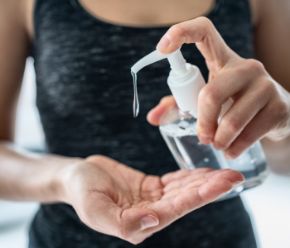
Some studies have also measured the difference that workflow conditions make. In one widely cited study, holding a receipt with wet hands after hand sanitizer use led to far more transfer than handling it with dry hands. That kind of finding is what turns this from a chemistry topic into a process topic.
Operational Takeaway
- The main issue is repeated contact, not one-off contact.
- One of the easiest details to miss is that sanitizer, lotion, or damp hands can significantly increase transfer during receipt handling.
- In the hand-sanitizer study, wet-hand contact led to much higher transfer than dry-hand contact, including a reported 185-fold increase after 60 seconds.
- A simple habit, keep hands dry before touching receipts, is one of the easiest control steps to implement.
Where barrier protection fits
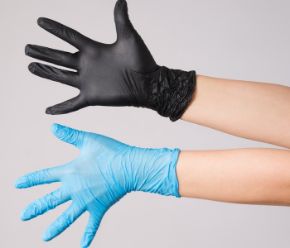
For teams that handle receipts constantly, gloves can be a practical way to reduce routine skin contact. They are not the entire answer, but in repeated-contact roles they can be a simple and realistic barrier step, especially when paired with dry-hand practices and reduced unnecessary printing.
Higher-contact environments where protection may make sense:
- Retail and checkout stations: Staff working through steady transaction volume and repeated receipt contact.
- Registration desks: Teams handling intake paperwork, receipts, and front-desk processing throughout the day.
- Pharmacy counters: Roles that involve constant paper exchange tied to prescription pickup and transaction records.
- Front-office administration: Workflows that involve sorting, filing, or processing printed transaction paper on a recurring basis.
Why hand sanitizer and wet hands matter
This is one of the most overlooked parts of the conversation. When hands are still damp, or when someone handles receipts right after using sanitizer or lotion, transfer can increase. That means the issue is not just the receipt itself. It is also the timing around how it is handled.
A better standard is simple and realistic: let hands dry fully before returning to receipt handling, especially in high-volume environments where the same task repeats throughout the shift. That recommendation now appears directly in worker guidance alongside other basic control steps such as washing before eating and limiting unnecessary printing.
A practical exposure-reduction approach
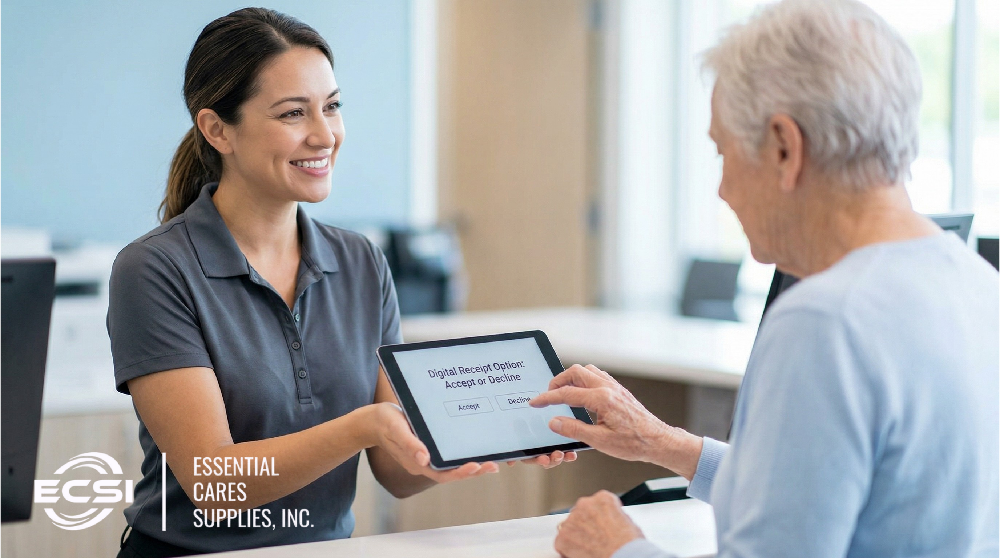
Offering digital receipts can reduce paper handling and simplify the workflow at the same time.
Small workflow changes can go a long way
Thermal receipts are not something most teams think twice about, which is exactly why they are worth looking at more closely. In environments where receipts are handled constantly, small workflow changes can make a meaningful difference.
The goal is straightforward: reduce avoidable contact, ask better material questions, and use barrier protection where it fits the job. For workplace safety and procurement teams, that is a practical and manageable standard.
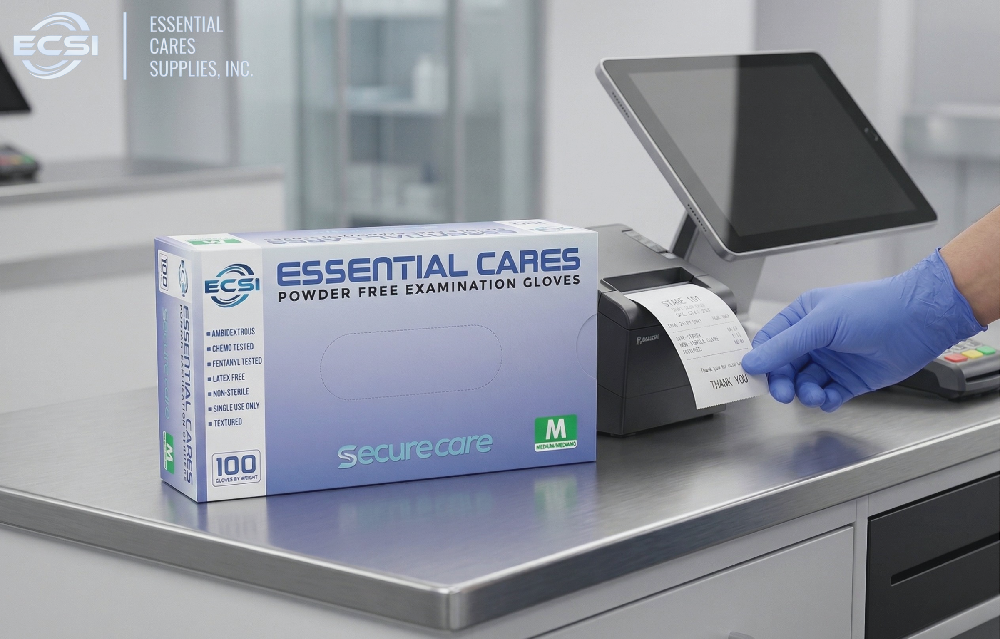
Support high-contact workflows with the right glove strategy
For teams handling receipts, documents, and other routine touchpoints throughout the day, the right glove choice can support a cleaner, more controlled workflow.
Frequently Asked Questions
What is BPA?
BPA stands for bisphenol A. It is a chemical used in certain plastics and resins, and it has also been used in thermal paper receipts.
Do thermal receipts always contain BPA?
Not always. Some use BPA, while others use different developers. That is why it is more useful to ask whether the paper is bisphenol-free rather than relying only on BPA-free wording.
Can receipt chemicals transfer to skin?
Yes. Research supports that transfer can happen, especially when receipts are handled repeatedly throughout the day.
Do gloves help with receipt handling?
They can. In higher-contact roles, gloves are a practical way to reduce repeated direct skin contact as part of a broader workflow approach.
Why do wet hands matter?
Wet hands, or handling receipts right after sanitizer or lotion, can increase transfer. Letting hands dry first is one of the simplest control steps.
Can people be tested for BPA exposure?
In some cases, yes. BPA exposure can be evaluated through urine biomonitoring, and some laboratories offer that type of testing. These results are generally better understood as a snapshot of recent exposure rather than a stand-alone measure of long-term health risk.
Sources
- National Institute of Environmental Health Sciences, Bisphenol A (BPA)
- NIEHS, BPA research overview
- Washington State Department of Ecology, Protect Yourself From Toxic Thermal Receipts
- Washington State Department of Ecology, Thermal Receipts Worker Guidance PDF
- PLOS ONE, receipt handling after hand sanitizer use
- U.S. EPA, biomonitoring for BPA
- Quest Diagnostics, urine BPA exposure monitoring test listing
 213-743-1401